

Are Small Language Models the New AI Default?
Part 1: How Smart Teams Route AI Work in 2026 + How to Run a Model on Your own Laptop Tonight.

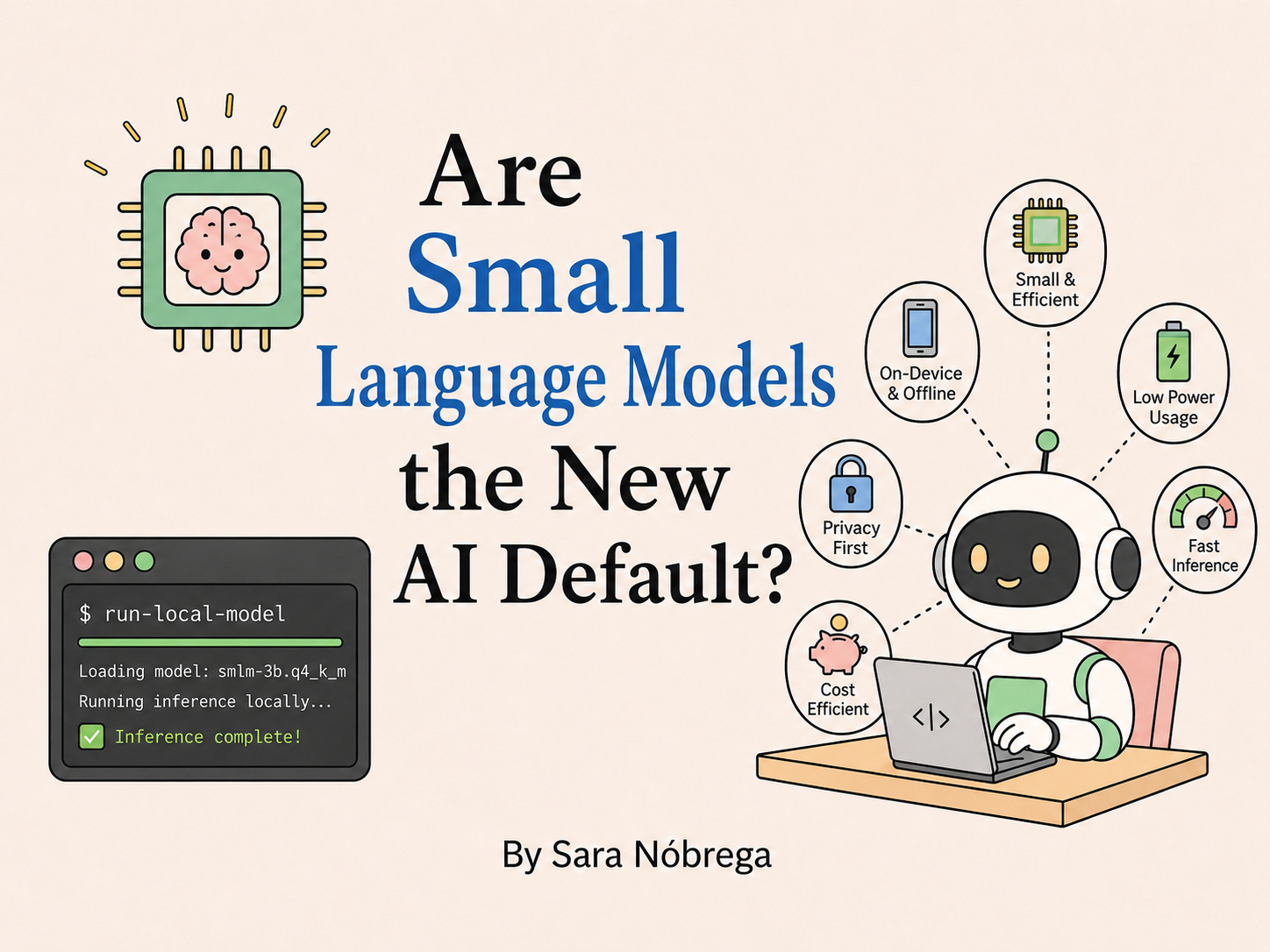
TLDR:
For three years the reflex was automatic: you had an AI task, so you called GPT or Claude. In 2026 that reflex is getting expensive, and a lot of the time it’s unnecessary.
A model running on your own laptop now handles a real share of production work: classification, extraction, summarization, code completion, document Q&A.
This is Part 1 of a short series on small language models.
Here I cover what changed, what you actually give up going small, and how to run your first local model tonight. My verdict: for a lot of work, start small and only reach for a frontier model when you can name the reason.
Why Is This important?
For most of the last three years, the choice made itself.
Open a browser and go to chatgpt/claude/gemini website. Or you called an API. Now, a lot of us use Claude Desktop/Claude code/Codex desktop app.
In 2026 that habit costs more than it used to, and often it buys you nothing. The internet is full of posts and threads about hitting usage limits within a few hours (or even less) of work.
People start naturally looking for solutions.
A model you run on your own laptop can handle a surprising share of real work.
The production versions of classification, extraction, summarization, code completion, and document Q&A that teams ship.
This already happened, quietly, while everyone watched the frontier labs trade benchmark records.
Five things shifted at roughly the same time between late 2025 and now: model capability, hardware, open-source tooling, token cost, and regulation.
Any one would matter. Together they moved small language models from a hobbyist toy to the sensible place to start a new project.
I’ll show you what changed, what you give up, and how to run one tonight.
First Intro
Before we start:
Save this and spend 10 minutes today listing the AI tasks in your work that are narrow and repetitive. Those are your small-model candidates.
Send it to any engineer or founder whose frontier API bill keeps climbing and who isn’t sure why.
Note
One definition first, because “small” is not accurate enough.
I’ll use SLM to mean models of roughly 1B to 14B parameters.
For mixture-of-experts models I count active parameters, so Qwen3-30B-A3B (3B active) counts.
By “frontier model” I mean GPT-5.x, Claude Opus 4.x, Gemini 3.x, Grok 4.
The boundary can be unclear, and that’s fine.
Why The GPT-By-Default Reflex Got Expensive
Headline API prices fell about 80% from early 2025 to early 2026.
Bills still went up for a lot of teams over the same period, for two reasons the price cuts didn’t touch.
Reasoning tokens are billed as output, and they run 3 to 5 times the length of the visible answer.
Agent conversations grow with every turn, because each turn resends the whole history.
👉 IntuitionLabs tracked one Claude conversation where a 14-token question cost $0.0018 at turn 1 and $2.41 by turn 260. That’s a 1,339x increase from accumulated history alone, for the same question!
Research also shows that the pattern teams are landing on is tiered routing:
roughly 70% local SLM,
20% mid-tier API,
10% frontier API.
For now the point is: the default of sending everything to a frontier model is where the cost comes from.
What Changed, And Why Now?
Reason #1: Capability
The clearest version of the case came from NVIDIA Research.
Their June 2025 paper, Small Language Models are the Future of Agentic AI (Belcak et al.), argued that the narrow, repetitive sub-tasks inside most agent pipelines don’t need a frontier model.
They estimated 40 to 70% of enterprise AI tasks can run on sub-10B models. The field was already drifting that way and the paper named it.
Capability is the part people underestimate. A 3B to 14B model today matches what a 70B model did 12 to 18 months ago on targeted tasks.
For those interested in numbers:
Microsoft’s Phi-4 (14B) scores 84.8 on MMLU and 82.6 on HumanEval, beating Llama-3.3-70B’s 78.9 on code.
Phi-4-reasoning-plus (14B) hits 77.7% on AIME 2025, matching the full 671B DeepSeek-R1 on that benchmark.
These models are built differently: trained on curated synthetic data, distilled from bigger teachers, quantized from day one instead of compressed after the fact.
Reason #2: Hardware
At the same time, hardware caught up.
NVIDIA’s DGX Spark shipped in October 2025 at $3,999 with 128 GB unified memory and runs models up to 200B parameters on a single unit.
AMD’s Framework Desktop does much of the same for $1,999.
A Mac Studio with M3 Ultra (800+ GB/s, up to 512 GB unified memory) can run a quantized DeepSeek 671B locally.
Even a 2026 flagship phone on a Snapdragon 8 Elite Gen 5 decodes at 100+ tokens per second.
Reason #3: Tooling Maturity
Tooling matured around all of it.
Hugging Face crossed 2 million public models.
Ollama became the default local backend, and LM Studio went free for commercial use in July 2025.
The number that stuck with me is from Hugging Face’s 2026 State of Open Source report: 92.5% of model downloads are for models under 1B parameters. Open-weight usage is overwhelmingly small.
Reason #4: Regulation
Regulation pushes the same direction.
Full enforcement of the EU AI Act’s high-risk obligations begins August 2, 2026, weeks from now (at the time of writing).
HIPAA never adapted to LLMs, and healthcare data breaches average $4.44M, the highest of any industry.
A May 2025 court order in NYT v. OpenAI required indefinite retention of even deleted ChatGPT chats, which made a lot of enterprises nervous about sending data to an API at all.
What You Give Up Going Small
Going small is a trade, and I want to be honest about the losing side first.
Frontier models still win the hard problems.
As of mid-2026,
GPT-5.4 scores 100% on AIME 2025 with no tools,
Claude Opus 4.6 hits 80.8% on SWE-bench Verified, and
Gemini 3.1 Pro reaches 94.3% on GPQA Diamond.
The best 30B coder SLMs top out around 50% on SWE-bench Verified.
Where SLMs fall behind is consistent:
deep multi-step reasoning,
coherent context past 128K tokens,
broad world and cultural knowledge,
frontier-grade coding across large codebases, and
depth in languages outside English and Chinese.
👉If your task lives in one of those, a small model will frustrate you.
One warning that’s easy to skip: running a model locally doesn’t make it safe.
In February 2025, ReversingLabs found malicious models on Hugging Face using broken pickle files to smuggle a reverse shell past the scanner, and they sat undetected for about eight months.
A single scanning pass that spring flagged 352,000 unsafe or suspicious issues across 51,700 models.
Prompt injection works the same against a local model, RAG content can carry instructions, and Ollama and LM Studio ship without safety classifiers by default.
Running locally changes who owns that risk. Now it’s you.
When A Small Model Is The Right Call
Here’s the call I’d actually make.
Reach for a small model when….
the task is high-volume and narrow: classification, extraction, routing, summarization.
Reach for one when latency matters, like autocomplete or voice, where you need first-token times under 100 ms.
Reach for one in privacy-regulated domains (healthcare, legal, finance, government) where the data can’t leave the building.
And reach for one for edge and offline work, or any workload pushing past a few million tokens a day, where the API meter becomes the dominant cost.
👉Stay with a frontier model when the work is open-ended or one-off: creative writing, research, debugging across a large unfamiliar codebase, or support across long-tail languages.
For low-volume work, under maybe 1,000 requests a day across varied tasks, the API is cheaper and better. Don’t fine-tune a small model to save $40 a month (in my opinion!).
The full decision rule, including the fine-tune-or-prompt question, is Part 2 of this series. This is the short version to get you started.
Run One Tonight
You can test all of this in about 10 minutes.
Install Ollama or LM Studio. From the model browser, pick a sensible default: Llama 3.2 3B, Gemma 3 4B, or Qwen3-4B-Instruct-2507 at Q4_K_M quantization. Then pull and chat:
# After installing Ollama from ollama.com

ollama pull qwen3:4b

ollama run qwen3:4b
Ollama exposes an OpenAI-compatible API on port 11434, bound to `127.0.0.1` by default, so nothing leaves our machine. We can point existing code at it by changing one line:
from openai import OpenAI

# Same SDK we’d use for the cloud, pointed at our local model

client = OpenAI(base_url=”http://localhost:11434/v1”, api_key=”ollama”)

resp = client.chat.completions.create(

    model=”qwen3:4b”,

    messages=[

        {”role”: “user”, “content”: “Summarize this support ticket in 3 bullets: ...”}

    ],

)

print(resp.choices[0].message.content)
A rule of thumb for fitting a model in memory at 4-bit: budget about 0.6 to 0.8 GB per billion parameters, plus 1 to 4 GB for context and overhead.
So 8 GB of RAM gets you 1 to 3B models, 16 GB runs a 7 to 8B comfortably, and 32 GB handles 13 to 14B (or a 27 to 30B model if you’re patient).
A 24 GB GPU like an RTX 4090 runs Gemma 3 27B (QAT) or Qwen3-30B-A3B well.
Set expectations honestly. A 3 to 8B local model is roughly a 2023-era GPT-3.5 for general chat: useful, not magical.
It’s good at summarization, rewriting, basic Q&A, code completion, and RAG over your own documents. It’s weak at deep reasoning, long multi-step problems, and niche factual recall.
Expect 10 to 40 tokens per second on a modern laptop, and 80 to 150 on an RTX 4090.
Why This Makes You a Power User of AI
Most people respond to an AI problem one way: pick a bigger model.
Knowing when a 4B model on your laptop does the job gives you a second option, the one that controls cost, latency, and where your data lives.
That’s the skill that makes you the AI person on a team right now.
Anyone can paste a prompt into a frontier API.
The person who can look at a workload and say “this 80% runs local for free, route the other 20% to the API, here’s the bill before and after” is the one making the architecture call.
Founders feel this most directly: it’s the difference between an AI feature with a $244K-a-year cost line and the same feature for a fraction of that.
I went in skeptical. I expected the local model to feel like a downgrade I was tolerating to save money. For narrow tasks, it didn’t feel like a downgrade at all.
What surprised me was how much of my own daily AI use is narrow and repetitive: cleaning up text, summarizing tickets, classifying notes, simple extraction. A 4B model handles that fine, offline, instantly, with nothing leaving my laptop.
The frontier model is still open in another tab for the genuinely hard things, and I notice I reach for it less.
The honest limitation: the moment a task needs real reasoning or long context, the small model’s quality drops sharply.
There’s no graceful degradation. It’s good until it suddenly isn’t. So the useful skill is knowing which side of that line your task sits on, which is exactly what Part 2 is about.
What’s Next
Part 1 was the case and the hands-on: why the default flipped, what you trade away, and how to run a model tonight.
If you only do one thing, install Ollama and pull `qwen3:4b`, then throw one of your real, boring AI tasks at it and see how far it gets.
Part 2 is the decision guide: a clear rule for when small wins versus when a frontier model still earns its price, and for ML engineers, whether to fine-tune a small model or keep prompting a big one (with QLoRA settings and an eval setup you can copy).
Part 3 is the money and the bigger picture: the tiered-routing math, the regulation deep-dive, and why owning your own model fits a wider shift.
If that sounds worth it, stay subscribed!
🎯 Need help navigating your own AI journey? Right now I’m offering:
AI consulting calls - If you’re working on projects or exploring how to bring AI into your business, I’d love to jump on a call and help you figure things out.
Mentorship sessions - Thinking about a career move or growing your skills in AI? I can share advice and help you map out your next steps.
Premium membership perk - If you’re a premium subscriber to this newsletter, you already have two 1:1 sessions with me included.
AI Engineering Mentorship Project - A structured, hands-on program where we build and deploy an AI/MLOps project together. You’ll learn production-grade skills through real code and weekly guidance.
For more info DM me or reply to this email!.
🙌 Learn AI is a reader-supported publication. Paid members get my Monthly AI Engineering Brief, where I break down what mattered in AI this month, what was hype, and what I’d learn/build next.
References
[1] P. Belcak et al., *Small Language Models are the Future of Agentic AI* (2025), arXiv:2506.02153
[2] Microsoft Research, *Phi-4 Technical Report* (2024), arXiv:2412.08905
[3] Hugging Face, *State of Open Source AI* (2026)
[4] ReversingLabs, *Malicious ML Models Discovered on Hugging Face (”nullifAI”)* (2025), ReversingLabs Blog
[5] OWASP, *Top 10 for LLM Applications 2025* (2024), OWASP Foundation
[6] European Commission, *EU AI Act Implementation Timeline* (2026), Official Journal of the European Union