

Create Your AI Brain Today
Part 3: How to design your own context layer before you build it

TLDR:
The problem: Every time you open a new AI conversation, your context resets. The solution is a local folder of plain text files that any AI can read, called a vault.
Part 1 explained why every AI conversation starts blank. Part 2 walked through the full architecture: two folders, a schema file, three control files, and a three-cadence automation layer.
But there is a layer in between that decides whether your vault actually works: knowing what belongs in it. This article gives you the five questions that answer that. And if you want to skip the setup entirely, I packaged my complete vault system so you can have yours running today.
If you read Part 1 and Part 2, you know the concept and you know the architecture. So why is your vault not running yet?
I have a guess: it is not the folder structure. Anyone can create two folders and a Markdown file. The thing that stops people is the blank page problem: what do I actually put in this thing?
That question has a method behind it. Today I am giving you mine.
Before we start:
Save this and spend 30 minutes answering the five questions below before you build anything. It will save you hours of restructuring later.
Send it to any engineer, founder, or friend who read Part 2, said “this is great”, and then never set it up.
Why Most Vaults Fail On The Content Layer, Not The Architecture
Here is the issue I keep seeing:
Someone reads about the vault approach and they get excited. They copy the folder structure, create the control files, maybe even schedule the automation. Two weeks later the vault is a ghost town. Stale files, empty folders, an AI that reads context that no longer matches reality.
The architecture was never the problem → the contents were.
A vault fails when what is inside it does not match how you actually work.
Too much content and the AI drowns in noise. Too little and it keeps asking you things it should already know. Wrong shape and you maintain files nobody reads.
Think of it like moving into a new house. The rooms are built. The question is what furniture goes where, and that depends entirely on how you live. Nobody else can answer it for you, but the right questions make the answer obvious.
The Five Questions To Answer Before You Build
Grab a blank note. Answer these honestly. Your answers are the blueprint for your vault.
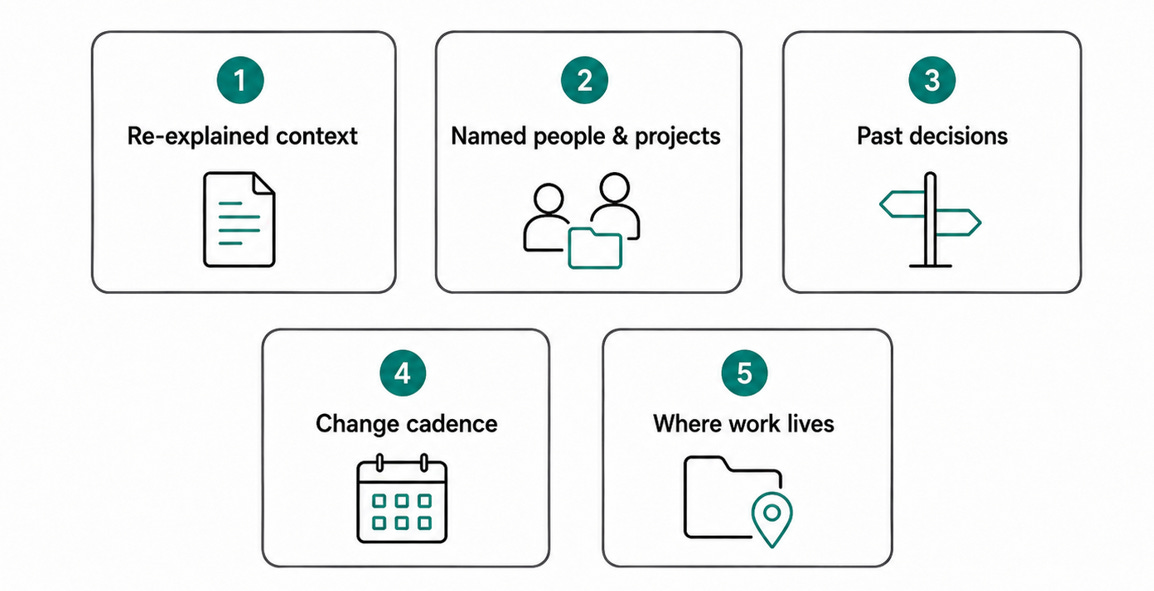
1. What do I keep re-explaining to AI?
Open your recent AI conversations and look for repetition. Your role, your company, your tech stack, your writing style. Anything you have explained more than three times belongs in the vault.
This is your fastest source of content because it is already written. You just have to extract it.
2. Whose context do I need referenced by name?
People, projects, clients, vendors, tools.
If you say “the marketing project” or “my colleague who owns the data pipeline” and expect the AI to know what you mean, those entities need files. One file per person or project, with enough context that the AI can reference them correctly.
3. What decisions am I tired of re-litigating?
The CRM you ruled out last quarter or the pricing structure you already settled. The framework you chose after two weeks of evaluation.
Decisions are the most underrated vault content. Without them, the AI happily re-suggests things you already rejected, and you waste time explaining why. Again.
4. What changes weekly, monthly, and never?
This question decides where things live. Weekly stuff goes in _hot.md: active threads, deadlines, open decisions. Monthly stuff goes in project files: status, next actions. The stuff that never changes goes in your preferences and business map files. If you mix these up, you end up rewriting stable context every week or reading stale urgency from a month ago.
5. Where does my work actually live?
Email, Slack, Notion, Linear, meeting transcripts. Your honest answer determines what the daily ingestion needs to pull from.
If most of your decisions happen in meetings, your vault needs transcripts flowing in. If everything is in your project tool, that is your primary source. The vault only stays alive if it feeds from where work actually happens.
How The Answers Map To The Structure
If you have the five answers, the architecture from Part 2 fills itself in.
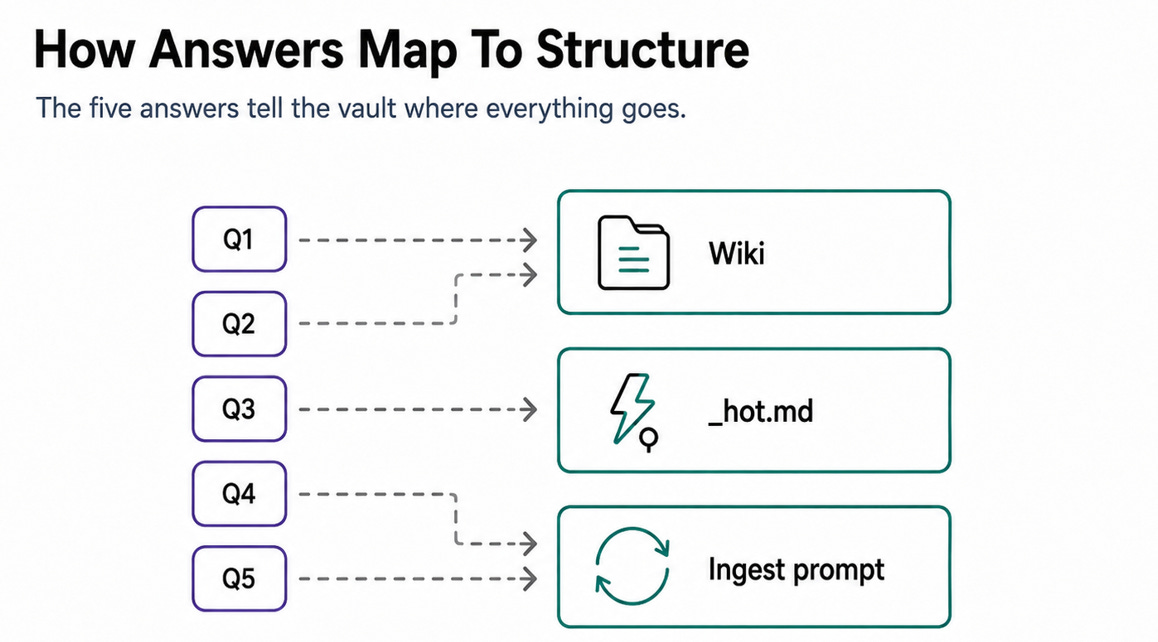
Question 1 and 3 populate your Wiki: the stable knowledge, the decisions, the context that needs to persist.
Question 2 tells you which files to create inside it.
Question 4 splits content between
_hot.mdand everything else.Question 5 writes your daily ingestion prompt, because now you know exactly which tools it needs to check.
The blank page problem disappears. You are not staring at empty folders anymore. You are filing answers you already have.
A Worked Example
Let me make this concrete with a solo founder I will call Ana. She runs a small e-commerce operation, works with two freelancers, and manages everything through Notion and email.
Her five answers:
She keeps re-explaining her product catalog, margins, and brand voice
She references her two freelancers, her supplier, and three active projects by name
She already decided against paid ads this year and ruled out two fulfillment partners
Orders and supplier issues change daily. Project status changes weekly. Brand voice never changes.
Everything lives in Notion and Gmail
Her vault almost builds itself. A business map file with catalog and margins. A brand voice file in preferences. One file per freelancer and per project. A decisions log with the ads call and the rejected partners. A daily ingest prompt that checks Notion and Gmail every morning and rewrites `_hot.md`.
Thirty minutes of answering questions, and the structure stopped being abstract. That is the whole method.
Why This Makes You A Power User Of AI
The people getting real leverage from AI design their context layer around their actual work. Their vault answers the questions their AI actually gets asked. Their automation pulls from the tools they actually use. Nothing is decorative.
That is the difference between having a vault and having your vault. The five questions are how you get the second one.
And once you have it, every conversation with AI starts from full context instead of zero. That advantage compounds every single week.
Skip The Setup: The Complete Vault Kit
After Part 2, the most common message I got was some version of “can I just have your files?”
So I packaged the complete system.
Not a starter version, but the full vault from Part 2, pre-built: folder structure, schema, control files, automation prompts, and step-by-step instructions. You answer the five questions from this article, drop your answers in, and your vault runs today!
Tier 1: Vault Kit - The complete system, ready to use:
Full folder structure from Part 2: Raw, Wiki, and all three control files
CLAUDE.md schema pre-written with the operating rules and prompting defaults
Starter content in every core file: _hot.md, project template, preferences template
All three Claude Cowork automation prompts: daily ingestion, weekly compilation, monthly linting
Step-by-step setup instructions: follow them top to bottom and your vault is live by end of day
Tier 2: Vault Kit Plus Implementation Call (limited to 5 spots)
-Everything in Tiers 1, plus:
A one-hour implementation call with me where we customize the vault to your actual work and tools
You bring your five answers, your issues and questions, and I help you turn them into a running system
Meeting Transcript
Not ready to buy yet? No problem! Everything you need to build this yourself is in Part 1 and Part 2. The kit just saves you the setup time :).
What’s Next
Answer the five questions this week. Build from scratch with Part 2, or grab the kit and have it running today.
If you enjoyed reading it, stay subscribed!
🎯 Need help navigating your own AI journey? Right now I’m offering:
AI consulting calls – If you’re working on projects or exploring how to bring AI into your business, I’d love to jump on a call and help you figure things out.
Mentorship sessions – Thinking about a career move or growing your skills in AI? I can share advice and help you map out your next steps.
Premium membership perk – If you’re a premium subscriber to this newsletter, you already have two 1:1 sessions with me included.
For more info DM me or reply to this email!
Learn AI is a reader-supported publication. To receive new posts and support my work, consider becoming a free or paid subscriber.
Very interesting! Writing about the new relationship between human and artificial intelligence: what AI changes, and how we can learn to use it as a partner in thinking. Let me know what you think!
https://apattichis.substack.com/p/introducing-two-minds
Reading this was funny in one specific way — your Ana example is roughly me: solo e-commerce founder, vault running inside the business for the past year. So take this as a field report from inside your case study.
Agree hard that vaults fail at the content layer, and "decisions as an underrated content type" deserves underlining twice. The layer I'd add: questions like these surface the knowledge you know you have — facts, names, settled decisions. The most valuable content never shows up that way, because you don't know it exists: the judgment calls you make mid-task and forget the second they're done. Case in point: my customer-service replies turned out to run on a whole decision tree I'd never once written down — it only surfaced when I got questioned about it, case by case. Facts can be exported. Judgment has to be pulled out of you.
So my candidate for question six: what did you decide today that you couldn't have written down this morning?